FORT COLLINS, Colo. (Reuters) – The recent heatwave was largely welcomed by the U.S. Crop Watch producers as the cooler May slowed development, but the western and northern locations are in immediate need of rain in order to maintain good conditions.
Temperatures in North Dakota touched 100 degrees Fahrenheit (38 Celsius) for two consecutive days this weekend, but as of Sunday the Crop Watch corn looked better than in the previous week because the heat was needed to pop the plants. However, health will deteriorate this week without rain as drought is still very worrisome.
High winds have also caused problems in North Dakota, which combined with the heat dries out the fields quicker and sometimes damages plants if sufficiently severe. Winds have recently raised concerns in South Dakota, Nebraska, western Iowa and Minnesota, as well.
Some growers in these locations noted that conditions will decline this week without rain, especially with the expected warmer temperatures, but the crops remain in mostly good shape for now.
Most of the Corn Belt is seen remaining generally drier than normal over the next two weeks, but weather models as of early Monday disagree on some areas. The American model suggests plentiful rain could arrive in North Dakota and parts of South Dakota in the coming days, but the European model shows drier conditions prevailing.
Models continue to indicate that most of June will be warmer than normal, especially in western and northern areas. However, there is a chance for average or even cooler temperatures moving into the second half of the month for eastern locations.
In Kansas and eastern areas including Ohio, Indiana and southeastern Illinois, recent weather conditions have been mostly ideal and the forecast for the upcoming week is also favorable. None of those areas need rain in the coming days, but the Kansas producer is eying a potential long, dry stretch ahead.
Weather in western Illinois and eastern Iowa has also been largely supportive except for some excessive rains last month that caused some holes in Illinois. Eastern Iowa is getting dry and needs some rain soon, but the situation is not yet critical. Temperatures in these spots are looking good for the week ahead.
STABLE RATINGS
Crop Watch 2021 has been following 11 corn and 11 soybean fields in nine major U.S. producing states each week through harvest. This is the fourth consecutive year for the project, though three new locations were added this year: South Dakota, western Iowa and western Illinois.
The producers each week assign condition scores to their fields using a scale of 1 to 5. The ratings are similar to the U.S. Department of Agriculture’s system where 1 is very poor and 5 is excellent, but the Crop Watch condition scores do not incorporate yield assumptions.
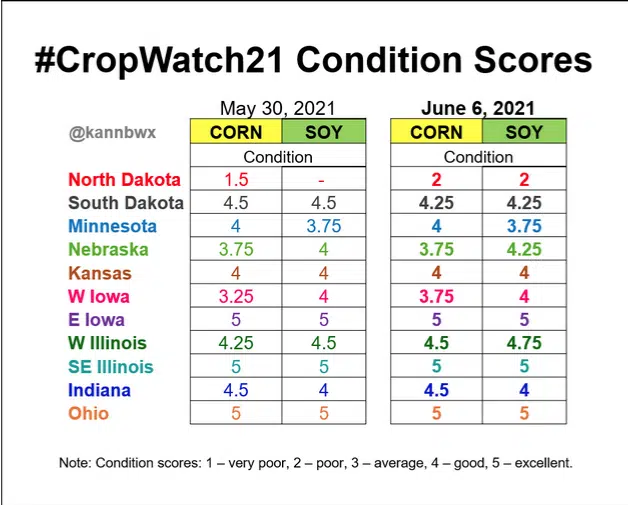
The 11-field corn average rose to 4.16 from 4.07 in the prior week as improvements in North Dakota, western Iowa and western Illinois offset a slight cut in South Dakota.
The North Dakota producer placed his initial soybean rating at 2, putting the 11-field average at 4.18. The 10-field average a week earlier was 4.38, but if excluding North Dakota this week the score would have risen to 4.4 with increases in Nebraska and western Illinois offsetting a trim in South Dakota.
Perfect corn and soybean scores continue in eastern Iowa, southeastern Illinois and Ohio. Nebraska and western Iowa corn are at 3.75 and North Dakota is at 2, but all other growers rate their corn in the 4-range.
The Minnesota soybeans are rated 3.75, but aside from North Dakota and the three 5 ratings, all other soybean fields are in the 4-range.
The following are the states and counties of the 2021 Crop Watch corn and soybean fields: Griggs, North Dakota; Kingsbury, South Dakota; Freeborn, Minnesota; Burt, Nebraska; Rice, Kansas; Audubon, Iowa; Cedar, Iowa; Warren, Illinois; Crawford, Illinois; Tippecanoe, Indiana; Fairfield, Ohio.
Photos of the 22 Crop Watch fields can be tracked on Twitter using the hashtag #CropWatch21.
The opinions expressed here are those of the author, a market analyst for Reuters.